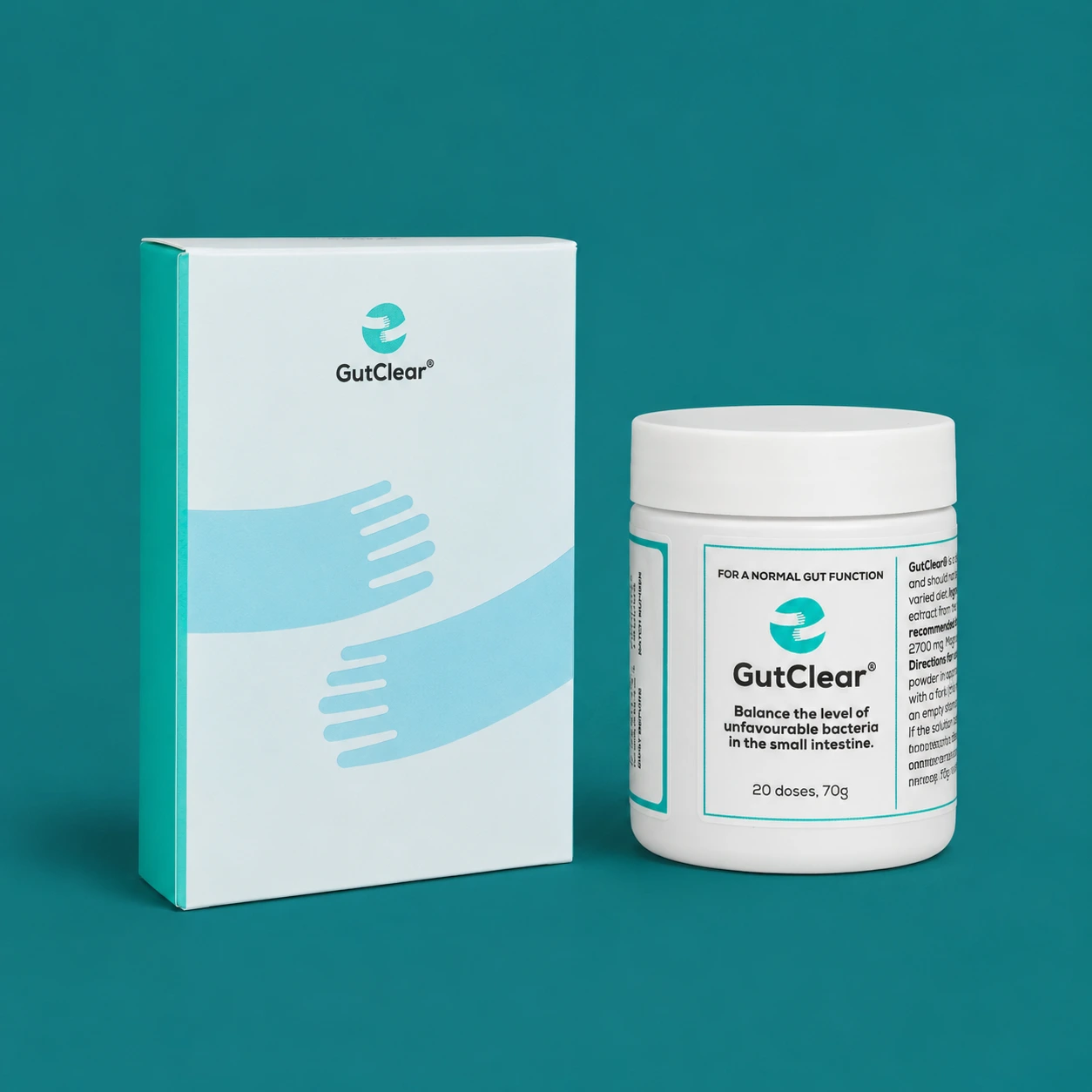
Many people choose to take GutClear® after periods of irregular eating, alcohol, poor sleep or stress as part of their routine to support digestive balance. Others take it regularly 1–2 times per week as part of their gut health routine.
If you have taken a round of 10-20 days with GutClear® and experience some persistent issues, we recommend that you continue immediately with a round of 10-20 days, alternatively 1-2 doses per week for 5-10 weeks.
We suggest a new round of GutClear® for 10-20 days straight, or as 1-2 doses per week for 5-10 weeks.
When comparing gut microbiome test results before and after using GutClear®, overall bacterial diversity is generally observed to remain stable. In some cases, an increase in diversity has been noted. This may indicate that the product’s ingredients primarily act in the small intestine, with limited impact on the bacterial composition of the colon.
In the small intestine, bacteria can utilize certain dietary components before they reach the large intestine. By supporting a balanced environment in the small intestine, more of these components may pass through to the colon, where they can be available to beneficial bacteria.
If you have experienced digestive imbalances for a longer period, you may notice temporary symptoms such as mild flu-like feelings or nausea during the first 1–3 days of using GutClear®.
These effects may be related to changes in the gut environment as your body adjusts. They are typically short-lived.
If this occurs, you may consider taking a short break from GutClear® for 1–2 days before resuming use.
We recommend that you continue to take GutClear® at the same dose daily for another round of 10-20 days, alternatively, take 1-2 doses of GutClear® per week for 5-10 weeks.
Eat as you usually do. If you wish to eat food containing lactic acid bacteria (fermented food, cottage cheese, yogurt, kefir), please have these in the afternoon (when you have taken GutClear® 20 min in the morning). These extra bacteria can reduce the effect of GutClear® on the bacteria that have colonized the small intestine (SIBO).
It's about preventing new colonization (overgrowth) of bacteria in the small intestine. You can do this by taking a dose of GutClear® as needed when you feel discomfort in your stomach. It is also important to keep bowel activity going, for example, by avoiding chronic stress, as this may inhibit bowel movements. Try to find something that gives you recovery, such as walking, mindfulness, yoga, and - if possible - avoiding chronic stress.
Chronic stress affects and inhibits the body's longest nerve, the vagus nerve. Whose nerve endings enter the intestinal wall and stimulate intestinal peristalsis (bowel movements) and digestion. Stress can also cause the valve between the large and the small intestine to not function optimally, i.e., not keeping tight. The critical task of the valve is to prevent bacteria from migrating from the large intestine to the small intestine and, thus, the overgrowth of bacteria in the small intestine.
Stress is a natural part of life and helps the body respond to increased demands. However, long-term (chronic) stress may affect normal digestive function and contribute to an imbalance in the gut environment.
Under normal conditions, most digestion of dietary fiber takes place in the large intestine, which is adapted to handle large amounts of bacteria. The large intestine also has a thicker protective mucus barrier compared to the small intestine.
If increased bacterial activity occurs in the small intestine, fiber may be broken down earlier than intended. This can be associated with digestive discomfort, such as bloating or a feeling of tension between meals.
In English-language literature, this condition is often referred to as Small Intestinal Bacterial Overgrowth (SIBO), a term used to describe increased levels of bacteria in the small intestine.
The small intestine is not made to handle high amounts of bacteria. Suppose there are too many bacteria in the small intestine. In that case, the digestion of fibers from the diet occurs there. It results in unfavorable gas production and other bacterial byproducts that can irritate the small intestinal mucosa. This negatively affects the nervous system and the immune system along the small intestine.
The reason is that the small gut is not designed to contain large amounts of bacteria since its wall is not protected by the thick mucous layer seen in the large intestine (which is designed to hold large amounts of bacteria). The small intestine is sometimes called "the little brain" because of the large number of nerve cells located along the small intestine wall. A large part of the body's immune system is also located along the mucosa (lining) of the small intestine. In SIBO, by-products from the metabolism of bacteria can damage the mucosa of the small intestine, leading to increased permeability (a leaky gut), thereby negatively affecting the nerve and immune cells in the small intestine wall.
If you have SIBO, increased dietary fiber intake can provide additional nutrition to the bacteria and produce even more gas and bacterial byproducts, worsening the discomfort you already have.
With GutClear® the bioactive and microbe-balancing substances can be continuously secreted as it passes through the small intestine. By balancing bacteria in the small intestine, bacterial digestion of dietary fiber can be prevented from occurring there and instead take place in the large intestine which, unlike the small intestine, is adapted for this bacterial breakdown process.
Yes, but take only 1 capsule per day.
We analyze the presence of a well-known marker for leaky gut (lactulose) and bacterial metabolites that accumulate in the bladder during the 90 minutes it takes for the fiber solution to pass through your small intestine. Elevated levels of lactulose indicate increased intestinal permeability (leaky gut), while the presence of specific bacterial metabolites indicates SIBO.
Because our test detects metabolites from a broad range of gut bacteria, we can more reliably determine if bacteria are present in the small intestine. It only takes one metabolite exceeding the reference range for your condition to be classified as SIBO.
If your test result is positive for leaky gut and/or SIBO, you’ll receive personalized dietary and supplement advice, as well as suggestions for lifestyle changes to support your well-being.
The test measures the presence of a well-known marker for leaky gut (lactulose, not to be confused with lactose) and bacterial metabolites that can only be produced by bacteria as the fiber solution passes through the small intestine. The metabolites are detected using a highly advanced mass spectrometry system (Agilent Ultivo).
A sensitive and bloated stomach, food intolerances, joint and muscle pain, eczema, fatigue, brain fog, low mood, headaches, and sugar cravings may all be caused by leaky gut. One common cause of leaky gut is bacterial overgrowth in the small intestine (SIBO), which can develop due to factors such as chronic stress.
Yes, significantly. Avoid taking lactulose-based laxatives (Lactulose/Duphalac®), fermented foods, curry, turmeric, and curcumin supplements two days before the test. Bulk-forming or osmotic laxatives do not interfere with the analysis.
No. Since our test analyzes bacterial metabolites from bacteria in the small intestine, taking probiotics or synbiotics could affect the results by introducing additional bacteria.
We’ve developed a completely new method for SIBO, Leaky Gut & TMAO. The test is based on mass spectrometry, identifying both a known marker for leaky gut (lactulose) and bacterial metabolites in a single analysis. This approach is unique on the market, as it measures metabolites from a wide range of bacteria (not just gas-producing ones) and uses a urine sample-allowing metabolites to accumulate in the bladder during the 90 minute passage of the fiber solution’s passage through the small intestine. By this, a significantly higher sensitivity for detecting bacteria in the small intestine is accomplished.
Yes-provided there is no allergy or sensitivity to the ingredients. The fiber solution contains compounds found in everyday foods: glucose, curcumin, and lactulose (the latter also forms when milk is heated). The powder is dissolved in a glass of water and the dosage is adjusted according to weight (e.g., adults drink a full glass, someone around 40 kg drinks half a glass, etc.).
All analyses are carried out at our laboratory in Lund, Sweden, using commercial systems (Agilent) routinely used for clinical testing.
The test data belongs to Gutfeeling Labs. We do not sell your test results, data, personal information, or similar. You can read more about how we comply with GDPR in our Privacy Policy.
This varies greatly-from as little as one day to several months. It depends on how long leaky gut and/or SIBO has been present and how much of the small intestine is affected by SIBO. Our experience is that GutClear® speeds up the recovery.
Yes. The analysis is linked to a specific person and account only when the kit is registered (e-mail coupled to the test-kit-ID). Instructions for this process are included in the kit.
Orders are usually shipped the following business day. International Delivery via PostNord typically takes 5–10 business days.
Your test kit can be stored at room temperature for up to 18 months. Once the test is completed, it should be mailed ideally as soon as possible; however the sample is stable in room and outdoor temperature over 3 weeks.
No, this is not a diagnostic test and cannot be used for medical diagnosis. It identifies conditions in the small intestine, but neither SIBO nor leaky gut nor TMAO nor Imp are officially recognized medical diagnoses in Sweden.
No, pregnancy does not affect the results.